This was my longest week of the build-up for McNaughton and my hamstring is continuing to cooperate for the most part. I generally record everything by time, but this week I started using a GPS watch for a few of the runs (thanks to CRUDer Harsha for loaning it to me). I wanted to check out a few of the typical runs I do, and it turns out they were a bit longer than I had been estimating which is always nice to find out. I'm going to have a few rough days at the beginning of this week while driving to Northern California and back, but I'm going to try to sneak in a run on Tuesday morning in Auburn CA (perhaps on the WTC course).
Mon 03/17 – 0
Tue 03/18 – 1:13:55 / 10.5 miles (GPS) out and back on Spruce Mt. Rd. I did a measured 5 rolling miles @ 6:40 pace in the middle of run which felt good.
Wed 03/19 – 0. A little sick.
Thu 03/20 – 1:43:00 hilly, in and around Garden of the Gods. Including 3.2 mile uphill tempo run up Rampart Range Road (23:30 vs. 24:14 last week).
Fri 03/21 – 1:30:00 windy run on Santa Fe trail (12 miles GPS)
Sat 03/22 – 3:00:00 Greenland / Spruce Meadows / Spruce Mt (21 miles GPS). Nice except for some crusty snow and ice on Spruce Mountain.
Sun 03/23 – 2:33:00 Santa Fe trail – Stables trail – Falcon Loop. 4 inches of nice fresh powder from last night made for a beautiful morning run.
Week – 10:00:00 / 75 miles
Sunday, March 23, 2008


Tuesday, March 18, 2008
Weighty Issue, Part 2
What's the single best way for most runners to improve their performance? Lose some weight. Here is a list of reasons to lose weight:
1. Your Max Vo2 will rise. Think of a car; if you tear out a bunch of extra junk from the trunk, but leave the engine alone, the all important horsepower/pounds ratio increases. And this ratio is the auto equivalent of your Max Vo2 reading. While Max Vo2 isn't as important to a 100 mile runner as it is to a miler, the idea is to have the same cardiovascular output but a smaller body to push up and down hills. If you weight 180 pounds now, and manage to lose 20 pounds, you'll use less energy and burn less calories at the same pace.
2. Less stress/pounding means less likely to sustain an injury. Running is a pounding exercise, and any lessening of this pounding is bound to help your knees, achilles, etc.
3. You are likely to live longer and suffer less non running related health issues. Ever seen a fat 100 year old? Seriously, just because you can run a 50 or 100 mile race doesn't meen you are healthy.
I was thinking of weight recently in the context of shoe weight. Finding the lightest shoes seems to be a common topic with a lot of runners (and I too prefer lighter shoes) but I find it odd that many people will agonize over an ounce here or there on their shoes, but neglect the dozen or so extra pounds they are carrying around on their bodies. Of course there are other reasons for choosing light shoes, as the lighter shoes often fit and feel better, and provide more flexibility. But, wearing the ultra light shoes also adds an element of injury risk (see 2 above) if you are carrying more than your ideal body weight. Just remember, a lot of the people you see wearing the lightest shoes are themselves light (Matt C, Tony K, etc). They would be great runners regardless of what shoes they wore.
1. Your Max Vo2 will rise. Think of a car; if you tear out a bunch of extra junk from the trunk, but leave the engine alone, the all important horsepower/pounds ratio increases. And this ratio is the auto equivalent of your Max Vo2 reading. While Max Vo2 isn't as important to a 100 mile runner as it is to a miler, the idea is to have the same cardiovascular output but a smaller body to push up and down hills. If you weight 180 pounds now, and manage to lose 20 pounds, you'll use less energy and burn less calories at the same pace.
2. Less stress/pounding means less likely to sustain an injury. Running is a pounding exercise, and any lessening of this pounding is bound to help your knees, achilles, etc.
3. You are likely to live longer and suffer less non running related health issues. Ever seen a fat 100 year old? Seriously, just because you can run a 50 or 100 mile race doesn't meen you are healthy.
I was thinking of weight recently in the context of shoe weight. Finding the lightest shoes seems to be a common topic with a lot of runners (and I too prefer lighter shoes) but I find it odd that many people will agonize over an ounce here or there on their shoes, but neglect the dozen or so extra pounds they are carrying around on their bodies. Of course there are other reasons for choosing light shoes, as the lighter shoes often fit and feel better, and provide more flexibility. But, wearing the ultra light shoes also adds an element of injury risk (see 2 above) if you are carrying more than your ideal body weight. Just remember, a lot of the people you see wearing the lightest shoes are themselves light (Matt C, Tony K, etc). They would be great runners regardless of what shoes they wore.
Sunday, March 16, 2008
100 for the week!
Ok, so it was only 100 kilometers but still, a good week for me. I upped my mileage, and also did a moderate hill workout on Thursday which didn't seem to bother my hamstring any. The only run that really bothered it much was the Saturday CRUD long run, in which we did encounter some hilly snow in the upper part of Bear Creek Park. Given the good last few weeks, I am now planning on running the McNaughton 100 Mile Trail race on April 12. I don't know a lot about it, but it is 10 loops of mostly singletrack; looks like it is rolling the whole way with quite a bit of cumulative elevation gain, but no long hills. It should be a good one to do with no crew, since I can get my stuff every 10 miles. Karl has the CR at 17:40something, which seems doable on paper, but anything can happen in a 100. I'll make a time prediction prior to the race.
Mon 03/10 – 0
Tue 03/11 – 1:31:00 out and back on Spruce Mt. Rd. 7:15 pace
Wed 03/12 – 46:00 around town 7:40 pace
Thu 03/13 – 1:05:00 Uphill tempo run on Rampart Range Rd (24:00) and then down through Glen Eyrie/Garden of the Gods
Fri 03/14 – 0
Sat 03/15 – 2:33:00 Monument Valley – Bear Creek Park – Lower Gold Camp Rd and back.
Sun 03/16 – 2:00:00 on treadmill. 7:24 pace
Week – 7:55:00 / 62 miles
Mon 03/10 – 0
Tue 03/11 – 1:31:00 out and back on Spruce Mt. Rd. 7:15 pace
Wed 03/12 – 46:00 around town 7:40 pace
Thu 03/13 – 1:05:00 Uphill tempo run on Rampart Range Rd (24:00) and then down through Glen Eyrie/Garden of the Gods
Fri 03/14 – 0
Sat 03/15 – 2:33:00 Monument Valley – Bear Creek Park – Lower Gold Camp Rd and back.
Sun 03/16 – 2:00:00 on treadmill. 7:24 pace
Week – 7:55:00 / 62 miles
Sunday, March 9, 2008
03/03 - 03/09 Log
Another good week, with even a few miles of faster running mixed in. The hamstring is hanging at about a 2 on the pain scale, which is very manageable. The main thing I look for with any kind of injury is if I seem to be changing my stride at all (which will lead to other problems). At this point, everything looks good in that respect. The American River 50 is out for sure now as I won't even be in California that weekend; I've moved up the delivery of some furniture I'm building for a client in Sacramento so I can be here in town for Judy's surgery on April 1st. But, I am leaning towards doing a trail race the weekend of April 12 if things continue to progress. I generally like to do big (for me) weeks 5, 4, and 3 weeks out from a race so I'll ramp it up to about 60-70 miles the next 3 weeks.
Mon 03/03 – 0
Tue 03/04 – 45:00 on treadmill, 7:47 pace
Wed 03/05 – 0
Thu 03/06 – 50:00 on TM, 7:20 pace with last mile @ 6:40 pace
Fri 03/07 – 52:00 out and back on Spruce Mt. Rd. 7:20 pace
Sat 03/08 – 3:15:00 Hilly slow run. Garden of Gods, Glen Eyrie, Mine Scar, etc)
Sun 03/09 – 50:00 TM, 7:20 pace with last 1.5 miles @ 6:40 pace
Week – 6:27 / 50 miles
Mon 03/03 – 0
Tue 03/04 – 45:00 on treadmill, 7:47 pace
Wed 03/05 – 0
Thu 03/06 – 50:00 on TM, 7:20 pace with last mile @ 6:40 pace
Fri 03/07 – 52:00 out and back on Spruce Mt. Rd. 7:20 pace
Sat 03/08 – 3:15:00 Hilly slow run. Garden of Gods, Glen Eyrie, Mine Scar, etc)
Sun 03/09 – 50:00 TM, 7:20 pace with last 1.5 miles @ 6:40 pace
Week – 6:27 / 50 miles
Tuesday, March 4, 2008
02/25 - 03/02 Log
This was the week I started feeling like a real runner again. I am still gradually quickening the pace of each run, and did my first true long run since ATY.
Mon 02/25 – 0
Tue 02/26 – 45:00 on Treadmill, 7:35 pace
Wed 02/27 – 30:00 on TM, 7:30 pace
Thu 02/28 – 1:15:00 up and down Cheyenne canon
Fri 02/29 – 47:00 out and back on Spruce Mt. Rd, 7:30 pace
Sat 03/01 – 3:15:00, Falcon Trail from Woodmen trailhead (via Ice Lake and Stables). Measured at 22.75 miles. Only about 6 slow miles of snow and ice with the rest a good honest pace.
Sun 03/02 – 0
Week – 6:32:00 / 48 miles
Mon 02/25 – 0
Tue 02/26 – 45:00 on Treadmill, 7:35 pace
Wed 02/27 – 30:00 on TM, 7:30 pace
Thu 02/28 – 1:15:00 up and down Cheyenne canon
Fri 02/29 – 47:00 out and back on Spruce Mt. Rd, 7:30 pace
Sat 03/01 – 3:15:00, Falcon Trail from Woodmen trailhead (via Ice Lake and Stables). Measured at 22.75 miles. Only about 6 slow miles of snow and ice with the rest a good honest pace.
Sun 03/02 – 0
Week – 6:32:00 / 48 miles
Sunday, March 2, 2008
A Weighty Issue, Part 1
Should runners lift weights? I believe so. In fact, I think almost anybody, runner or not, can benefit from weight training. That doesn’t mean that lifting weights will automatically make you faster, or a better runner, but I think there are enough other benefits to make it worthwhile. And, if you are very weak or have muscle imbalances, weight training very well could improve your running. The program I use focuses on the core (chest/shoulders/back/abs) and legs. A person can run 100 miles and still have very weak legs. Especially if you lack long hills in your area, adding some leg exercises can help you when you are faced with hills in a race.
First, a little about physiology and a few misconceptions about weight lifting.
1. Lifting weights will make be muscle bound.
2. Lifting will take too long.
3. I don’t belong to a gym.
1. Body/Soma Types:
A system, developed by W.H. Sheldon, uses the terms ectomorph, endomorph, or mesomorph to describe the build of an individual. In the simplest terms, ectomorphs are those with lean, slight builds who don’t easily put on weight. Think Paul Tergat. Mesomorphs are those who are naturally more muscular and easily add muscle mass. Think Herschel Walker. And Endomorphs are those who tend to be soft and chubby, and have difficulty keeping their weight down. Think Jack Black. While a lot of Sheldon’s research is questionable (after identifying the 3 body types, he attempted to draw conclusions about the personalities that went with each) the basic idea of somatotyping is generally accepted by exercise physiologists. However, in actuality, most people have some characteristics of each body type. Knowing your body type(s) is helpful in determining your workout routines and diet.
So, for most people, and runners in particular (because most are ecotomorph type builds) adding muscle is hard. When you combine the fact that you are doing many hours of an aerobic activity each week, you are not in danger of looking like Mr. or Mrs. Olympia from a basic lifting routine. And, if you are that 1 in a million freak of nature, you’ll be the envy of all your skinny runner friends.
2. Strength Endurance
For distance runners, strength endurance is much more important than raw explosive power, so the lifting routine I use and recommend for other runners is a fast-paced circuit training/Superset routine. This allows you to complete your lifting in a minimal amount of time, and also adds an aerobic component to the workout. You’ll be moving from one exercise to the next quickly allowing one muscle group to rest while you exercise the next one. This also limits the chance of building up any appreciable muscle mass.
3. Gym or Home?
While a Gym is ideal if you have access to one, you can do quite a lot of lifting at home with just a few dumbbells and a few machines. Also, at home you never have to wait for a machine making it easier to quickly move through your circuit. If you have the space, it also might be more cost-effective in the long run to start acquiring the necessary equipment. Check out Craigslist for good deals on equipment that people bought and never used.
Sample Lifting Routine:
In the following routine, do one set of each exercise and then move to the next. Start with 1 complete set and build up to 3 sets. Each set should be between 7 - 10 reps (first 2 sets) and 6 - 8 reps (final set). Try to select a weight that brings you close to failure by the end of each set. If you move quickly, you should be able to do each complete set (1 set of each exercise) in 10 minutes, meaning the whole workout is only 30 minutes. Strive for good form, even if it means less weight. Generally doing this 2 or 3 times a week is ideal. I show the abs as exercise 10, but you can save this one and do it anytime while you are watching TV or whatever.
1. Bench Press / Push-ups
2. Lat Pulls / Pull-ups
3. Pull-overs
4. Dumbell Shoulder Presses
5. Upright rows / power cleans
6. Good Mornings
7. Leg curls
8. Leg extensions
9. Calf raises
10. Abs/Obliques/Low back
Exercise Details
Below I show a few photos of each exercise and describe a little about each.
1. Bench Press (or Push Ups):
Lie on the bench and grasp the bar a little wider than shoulder width. Put your feet on the bench to avoid straining your back and/or cheating. Lower the bar to your chest and then powerfully push the bar back up till your arms or straight. Don't bounce off your chest.

2. Lat Pulls (or Pull Ups):
Grab the bar with a wide grip. Tuck your knees under the support (or get somebody to hold your shoulders) so the weight doesn't pull you up in the air. Lean back a bit, then pull the bar down till it touches your chest. I do 5 to the chest, then do the next 5 bringing the bar down behind my neck.

3. Shoulder Presses:
Get 2 dumb-bells and hold them in front of your shoulders with your palms facing your body. Push them up at the same time, rotating your hands till your hands are facing away from your body at the top.


4. Pullovers:
A great exercise for expanding your chest and working the serratus. Lie on your back with a dumb-bell, holding as shown. With only a slight bend in your elbows, lower the weight over and behind your head, feeling the stretch. Reverse the motion, again keeping your arms almost straight.


5. Cleans (from a hang position).
One of the best single lifts for your core. Start with a very light weight till you get the feel for this one. Bend over and pick the barbell up till you are standing with arms straight down. This is the starting position. Bend slightly in the knees and then explosively drive up, using your legs to get the weight moving. Then using your upper back swing the weight up till it is high enough to bring your elbows in, supporting the weight against your chest. Lower the weight back to the hang position and repeat. 10 reps of this exercise will get your heartrate up higher than any speedwork.


6. Leg Curls:
Doing one leg at a time, curl each leg till it comes as close as possible to your butt.

7. Leg Extensions:
Again, use one leg at a time. Slowly extend your leg till your knee is straight. Hold it a few seconds, then slowly lower.

8. Calf Raises:
Use a calf machine, or use a step as shown below. Grab a dumb-bell in the same hand as the leg you'll be using. Lower your heel till you get a good stretch. Then flex your calf till you are on your tip toes.

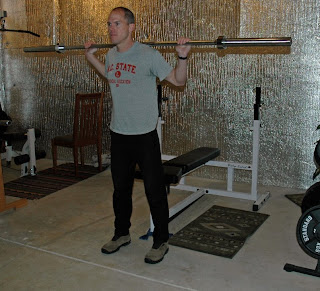
9. Good Mornings.
Great exercise for your lower back and hamstrings. It is very important in this lift to keep your back arched (lordosis). Avoid rounding your back even if it means not going down as far.

Sources Used:
Exercise Physiology; Energy, Nutrition, and Human Performance (McArdle, Katch, Katch)
Encyclopedia of Modern Bodybuilding (Schwarzenegger, Dobbins)
First, a little about physiology and a few misconceptions about weight lifting.
1. Lifting weights will make be muscle bound.
2. Lifting will take too long.
3. I don’t belong to a gym.
1. Body/Soma Types:
A system, developed by W.H. Sheldon, uses the terms ectomorph, endomorph, or mesomorph to describe the build of an individual. In the simplest terms, ectomorphs are those with lean, slight builds who don’t easily put on weight. Think Paul Tergat. Mesomorphs are those who are naturally more muscular and easily add muscle mass. Think Herschel Walker. And Endomorphs are those who tend to be soft and chubby, and have difficulty keeping their weight down. Think Jack Black. While a lot of Sheldon’s research is questionable (after identifying the 3 body types, he attempted to draw conclusions about the personalities that went with each) the basic idea of somatotyping is generally accepted by exercise physiologists. However, in actuality, most people have some characteristics of each body type. Knowing your body type(s) is helpful in determining your workout routines and diet.
So, for most people, and runners in particular (because most are ecotomorph type builds) adding muscle is hard. When you combine the fact that you are doing many hours of an aerobic activity each week, you are not in danger of looking like Mr. or Mrs. Olympia from a basic lifting routine. And, if you are that 1 in a million freak of nature, you’ll be the envy of all your skinny runner friends.
2. Strength Endurance
For distance runners, strength endurance is much more important than raw explosive power, so the lifting routine I use and recommend for other runners is a fast-paced circuit training/Superset routine. This allows you to complete your lifting in a minimal amount of time, and also adds an aerobic component to the workout. You’ll be moving from one exercise to the next quickly allowing one muscle group to rest while you exercise the next one. This also limits the chance of building up any appreciable muscle mass.
3. Gym or Home?
While a Gym is ideal if you have access to one, you can do quite a lot of lifting at home with just a few dumbbells and a few machines. Also, at home you never have to wait for a machine making it easier to quickly move through your circuit. If you have the space, it also might be more cost-effective in the long run to start acquiring the necessary equipment. Check out Craigslist for good deals on equipment that people bought and never used.
Sample Lifting Routine:
In the following routine, do one set of each exercise and then move to the next. Start with 1 complete set and build up to 3 sets. Each set should be between 7 - 10 reps (first 2 sets) and 6 - 8 reps (final set). Try to select a weight that brings you close to failure by the end of each set. If you move quickly, you should be able to do each complete set (1 set of each exercise) in 10 minutes, meaning the whole workout is only 30 minutes. Strive for good form, even if it means less weight. Generally doing this 2 or 3 times a week is ideal. I show the abs as exercise 10, but you can save this one and do it anytime while you are watching TV or whatever.
1. Bench Press / Push-ups
2. Lat Pulls / Pull-ups
3. Pull-overs
4. Dumbell Shoulder Presses
5. Upright rows / power cleans
6. Good Mornings
7. Leg curls
8. Leg extensions
9. Calf raises
10. Abs/Obliques/Low back
Exercise Details
Below I show a few photos of each exercise and describe a little about each.
1. Bench Press (or Push Ups):
Lie on the bench and grasp the bar a little wider than shoulder width. Put your feet on the bench to avoid straining your back and/or cheating. Lower the bar to your chest and then powerfully push the bar back up till your arms or straight. Don't bounce off your chest.

2. Lat Pulls (or Pull Ups):
Grab the bar with a wide grip. Tuck your knees under the support (or get somebody to hold your shoulders) so the weight doesn't pull you up in the air. Lean back a bit, then pull the bar down till it touches your chest. I do 5 to the chest, then do the next 5 bringing the bar down behind my neck.

3. Shoulder Presses:
Get 2 dumb-bells and hold them in front of your shoulders with your palms facing your body. Push them up at the same time, rotating your hands till your hands are facing away from your body at the top.


4. Pullovers:
A great exercise for expanding your chest and working the serratus. Lie on your back with a dumb-bell, holding as shown. With only a slight bend in your elbows, lower the weight over and behind your head, feeling the stretch. Reverse the motion, again keeping your arms almost straight.


5. Cleans (from a hang position).
One of the best single lifts for your core. Start with a very light weight till you get the feel for this one. Bend over and pick the barbell up till you are standing with arms straight down. This is the starting position. Bend slightly in the knees and then explosively drive up, using your legs to get the weight moving. Then using your upper back swing the weight up till it is high enough to bring your elbows in, supporting the weight against your chest. Lower the weight back to the hang position and repeat. 10 reps of this exercise will get your heartrate up higher than any speedwork.


6. Leg Curls:
Doing one leg at a time, curl each leg till it comes as close as possible to your butt.

7. Leg Extensions:
Again, use one leg at a time. Slowly extend your leg till your knee is straight. Hold it a few seconds, then slowly lower.

8. Calf Raises:
Use a calf machine, or use a step as shown below. Grab a dumb-bell in the same hand as the leg you'll be using. Lower your heel till you get a good stretch. Then flex your calf till you are on your tip toes.

9. Good Mornings.
Great exercise for your lower back and hamstrings. It is very important in this lift to keep your back arched (lordosis). Avoid rounding your back even if it means not going down as far.


Sources Used:
Exercise Physiology; Energy, Nutrition, and Human Performance (McArdle, Katch, Katch)
Encyclopedia of Modern Bodybuilding (Schwarzenegger, Dobbins)
Subscribe to:
Posts (Atom)

